Addiction & mental health · in‑home · Canada‑wide
You don't have to disappear
You don't have to disappear
to get sober.
Licensed Canadian clinicians treat addiction and co‑occurring mental health in your home. Same protocols a residential program runs. No 30‑day leave of absence. No admissions wing. No chart your family doctor or employer will ever see. Care can begin within 72 hours of the first call.
- Licensed Canadian clinicians · evidence‑based protocols
- Accreditation Canada Certified · NAADAC‑affiliated
- 80% of patients still doing well at 18+ months

You've already done the hardest part. You've stopped pretending.
If you're on this page, you've already worked through the math nobody else can do for you:
- Stopping on your own works. For a while. Then it doesn't.
- Going away for 60 days is not actually an option. Your job, your income, the people who depend on you, the questions you can't answer about where you've been — none of that survives a residential program.
- “Just see a counsellor” hasn't been enough, because what's underneath this isn't only behavioural. There's something in the chemistry, or the anxiety, or the sleep, or the trauma — and a 50‑minute Zoom call once a week doesn't reach it.
- Hitting bottom is a story other people tell. You don't actually want to find out what yours looks like.
You've been carrying this calculation alone for months. The thing you didn't have until now is the option that fits in the column where every other option fails.
You're not on this page because something is fine. You're on this page because you ran the numbers, and there was a piece missing.
We are the piece.
Here's why every other version of this has failed you.
| Option | Why it doesn't fit your life |
|---|---|
| Residential rehab (30–90 days inpatient) | Loses 1–3 months of income. Cannot be hidden. Career impact ranges from “complicated” to “career‑ending.” Most professionals never go. |
| Outpatient clinic (group sessions, fixed schedule) | Requires showing up, on time, in public, on a building's schedule. Attendance is exactly what addiction makes unreliable. The same fragility that brought you here is why you won't make it. |
| AA / NA on its own | Powerful peer support — but no clinical assessment, no licensed clinician, no medical oversight, no plan for the depression or anxiety underneath. |
| Family doctor referral | Often a 2–6 month wait. Most family physicians are not specialized in addiction medicine. The note in your chart is permanent. |
| Online counselling (BetterHelp, Talkspace) | A talk therapist, generally not addiction‑specialized, with no medical authority, no in-person clinical assessment, no protocol. Useful for stress. Not built for this. |
| Doing it alone, again | You already know the answer to this one. |
The reason this list exists in your head is that you've been doing the work. You've already evaluated every column. The version of help that fits the gap is the one this page is about.
Clinical reality
A licensed clinician at your kitchen table is not a softer version of treatment.
The first visit is a forty‑minute clinical assessment. Substance use history. Medical history. Sleep, mood, anxiety, trauma. Family system. Risk factors. Same depth of work a residential intake team does on day one — done in your kitchen instead of an admissions office.
Then a written plan, on paper, in your hand:
- Frequency of visits (typically 2–4 per week in the first 30 days, tapering)
- Which clinician(s), which protocols, what evidence base
- Medication review, where appropriate, with a physician on the team
- What we do if you relapse during treatment (we don't discharge you for it)
- What we do at the 6‑month and 12‑month mark, when most people quietly fall off
You approve it. Then it begins. In your home, on your schedule.
Talk to a clinician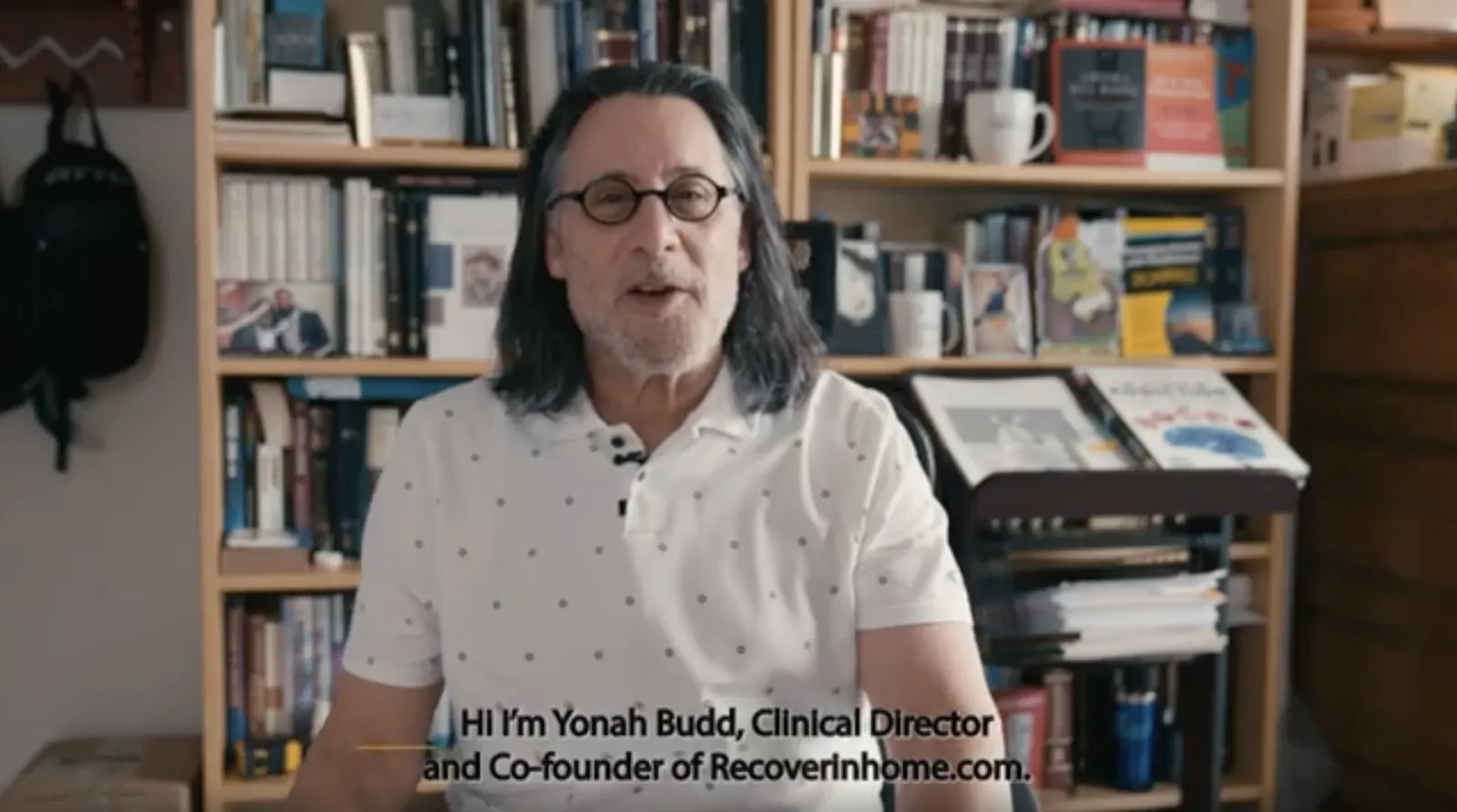 Yonah & team — what the first 30 days actually look like1:30
 YonahClinical lead & founder
What your week looks like in treatment
Week 1
Clinical assessment in‑home. Written plan delivered and reviewed. First two sessions begin.
Weeks 2–4
2–4 in‑home sessions per week. Co‑occurring conditions addressed in parallel. Clinical lead reviews your file weekly.
Months 2–3
Frequency tapers. Skills work moves to the foreground — life balance, urge control, situational triggers.
Months 4–12
Maintenance cadence. The window where most relapse happens — and where most programs no longer cover you.
Month 18
The marker we measure against: 80% of our patients are still doing well here.
What this looks like, start to finish.
- 01
Talk to a clinician.
Not a salesperson, not a call‑centre intake. A 30‑minute conversation with someone clinical. We listen, we ask the questions that actually matter, and we tell you honestly whether in‑home is the right fit for your situation. If it isn't, we'll point you to something that is.
- 02
A clinical assessment, in your home.
A licensed clinician runs the full assessment — substance use, medical, mental health, family system, risk. This is real clinical work. The data goes nowhere outside our team without your written consent.
- 03
A written, individual plan.
Goals, frequency, the team, the protocols, the medication review if relevant, the role family members can play if you want them involved (and the option to keep them entirely outside it). You sign off before any treatment begins.
- 04
Treatment, on your schedule.
Sessions in your home, around your work and life. Crisis support 24/7. Frequency adjusts as recovery stabilizes — not on a calendar's schedule, on yours.
- 05
The 18‑month window most programs don't cover.
The data on relapse is unkind: most relapse happens after the program ends. We don't have a discharge date. We walk through the high‑risk window with you. That's why our 18‑month outcome is what it is.
This isn't really about the substance.
The substance is the symptom. What you're buying is the version of yourself that walks back into your own life intact.
It's a Wednesday in nine months. You're in a meeting. Sober. Clear. The version of you that handles the meeting is the one you remember from before this started. No one in the room knows you almost lost the thread. That part is yours, and yours only.
It's dinner on a Saturday. You are present. Not negotiating internally with the wine on the table. Not running the math on tomorrow morning. Just there. With the people who, eight months ago, started to wonder if they still recognized you.
That is the job. The treatment is the mechanism. Recovery is the milestone. But the actual deliverable is the person you walk back into your own life as.
Three things most people don't know yet about clinical treatment.
-
“Either residential or nothing” is a false choice — and was never true.
For patients with a stable home and no acute medical detox risk, in‑home clinical treatment matches residential outcomes on abstinence and beats them on long‑term retention. The reason is straightforward: recovery skills built in the environment where life actually happens transfer better than skills built in a controlled residential setting they have to leave.
-
“In‑home” is not a softer or less clinical version of treatment.
Same licensed clinicians. Same evidence‑based protocols. Same medical oversight. The only thing that changes is the room. Recognized by Accreditation Canada (Primer Award), NAADAC‑aligned professional practice, and verified by Google's healthcare advertising review — three independent bodies whose entire purpose is to audit clinical legitimacy.
-
The 30‑day model is an insurance artifact, not medicine.
Thirty days is how long American insurance companies will pay for inpatient treatment. It is not how long the brain takes to repair. Real clinical research on addiction recovery is measured at 12, 18, and 24 months. The reason 80% of our patients are still doing well at 18+ months is that we are still there at 18 months.
Questions you've been afraid to ask out loud.
“Will my employer find out?”
No. We have zero contact with any employer, ever, unless you specifically ask us to. Our visits to your home are unmarked — no logos, no signage, no clinician in scrubs at your door. There is no insurance claim that goes to an HR department.
“Will it end up in my medical chart?”
Not unless you sign for it to. Your family doctor never has to know. We do not communicate with any other healthcare provider without your written consent — except in narrow circumstances required by Canadian law (immediate risk of harm to self or others, the same standard any clinician operates under).
“What if I'm not 'bad enough' to need this?”
The high-functioning pattern is the most common one we treat. Most of our patients have jobs, families, and a public life that looks intact. You do not have to hit a rock bottom to be eligible for clinical addiction care. Hitting it just means you went through more than you needed to.
“I've tried to stop alone and failed three times. Why would this work?”
Because we are not asking you to do the same thing again with more willpower. We're treating what's underneath — the chemistry, the anxiety, the depression, the trauma, the sleep, the situational triggers — at the same time as the substance. Willpower is not the variable that's been failing you.
“What if I relapse during treatment?”
Relapse during treatment is treated as clinical information, not as failure or grounds for discharge. It tells us what the protocol needs to address that it isn't yet. Our retention through relapse is part of why our 18‑month outcome is what it is.
“What does this cost?”
Cost depends on the plan — frequency, team composition, length. Some elements may be reimbursable under private insurance or extended health benefits. You receive a written estimate before anything starts. The first 30-minute call is free and obligation-free.
“What if I'm not ready to commit?”
Then don't. The first call is a conversation, not a contract. Many patients begin weeks or months after a first call. The point is better information — not extracting a yes.
The two things our patients say most often.

RecoverInHome helped me learn to manage my depression and anxiety while recovering from alcohol addiction. Yonah connected directly with my root issues to help me resolve them and move forward with my life. I got my life and family back.

I wouldn't be here without their support. They helped me when no one else could. They understood me and my challenges, and helped empower me to make changes so recovery felt natural. They were with me every step of the way.
Independently certified — audit trails you can verify.
 Ontario — community safety standards
Protocols aligned where mental health, addiction, and justice intersect.
 National Center for Crisis Management
Risk management for acute stabilization.
 NAADAC
Professional standards for addiction‑focused care.
 Canadian Mental Health Association
Recovery‑oriented community mental health alignment.
 Accreditation Canada
Primer Award — quality standards.
Next step
Thirty minutes. Then you have better information.
The first call doesn't commit you to anything. You don't have to be ready. You don't have to have a plan. You don't have to have decided. You need 30 minutes on the phone with a clinician who has done this with thousands of professionals and parents in exactly your situation.
After the call, you'll know:
- Whether in‑home is the right fit for you specifically
- What treatment would actually look like for your case
- What it would cost, written down
- What the next step would be — if you decide there is one
If we're not the right fit, we'll tell you that, and we'll point you to who is.
Nothing on this page is logged anywhere outside our intake system. No newsletter. No retargeting. No follow-up unless you ask for one.