Addiction & mental health · in‑home · Canada‑wide
Get your loved one into real addiction treatment —
Get your loved one into real addiction treatment —
without sending them anywhere.
Licensed Canadian clinicians treat addiction and co‑occurring mental health in the home — yours, theirs, or both. Care can begin within 72 hours of the first call. No residential program. No time away from work. No one outside the household needs to know.
- Licensed Canadian clinicians · evidence‑based protocols
- Accreditation Canada Certified · NAADAC‑affiliated
- 80% of patients still doing well at 18+ months

You didn't search this at random.
- It happened again last week — and this time the kids saw it.
- You found something in their car. Or their bag. Or their nightstand. Again.
- They got a call from work. Or a hospital. Or the police.
- Your partner has said the words “I can't keep doing this” out loud.
- You haven't slept properly in months and you don't recognize yourself in the mirror.
You're not researching this because something is fine. You're researching it because something specific happened, and the version of help you keep finding online is one your loved one has already refused.
We built this for that exact moment.
You've already mapped it out, haven't you?
Door 1 — Residential rehab
- 30 to 90 days away
- Loses their job
- Loses their income
- Family explains the absence to everyone
- They've already said no
Door 2 — “Just talk to someone”
- A counsellor once a week
- No clinical assessment
- No treatment plan
- No coordination with mental health
- They've tried it, it wasn't enough
Most families we talk to have stood in front of these two doors for months. One feels too big. The other feels too small. Neither one fits the actual life on fire in your kitchen.
There is a third door.
Licensed, in‑home clinical care can match the seriousness of residential treatment — without making your loved one disappear.
What in‑home really is
This is not a counsellor on a Zoom call.
A licensed clinician arrives at the door. With a stethoscope, a medical history form, and forty minutes of questions. Same assessment they would do in a residential intake — done in the kitchen instead of an admissions wing.
Then a written plan:
- Frequency of visits (typically 2–4 per week in the first month)
- Which clinician(s) and which protocols
- The role you and other family members can choose to play
- Goals, milestones, how relapse is handled if it happens
Care begins. Sessions in the home. Family in the room when it helps. A clinical lead who knows your file by name, not by chart number.
Talk to intake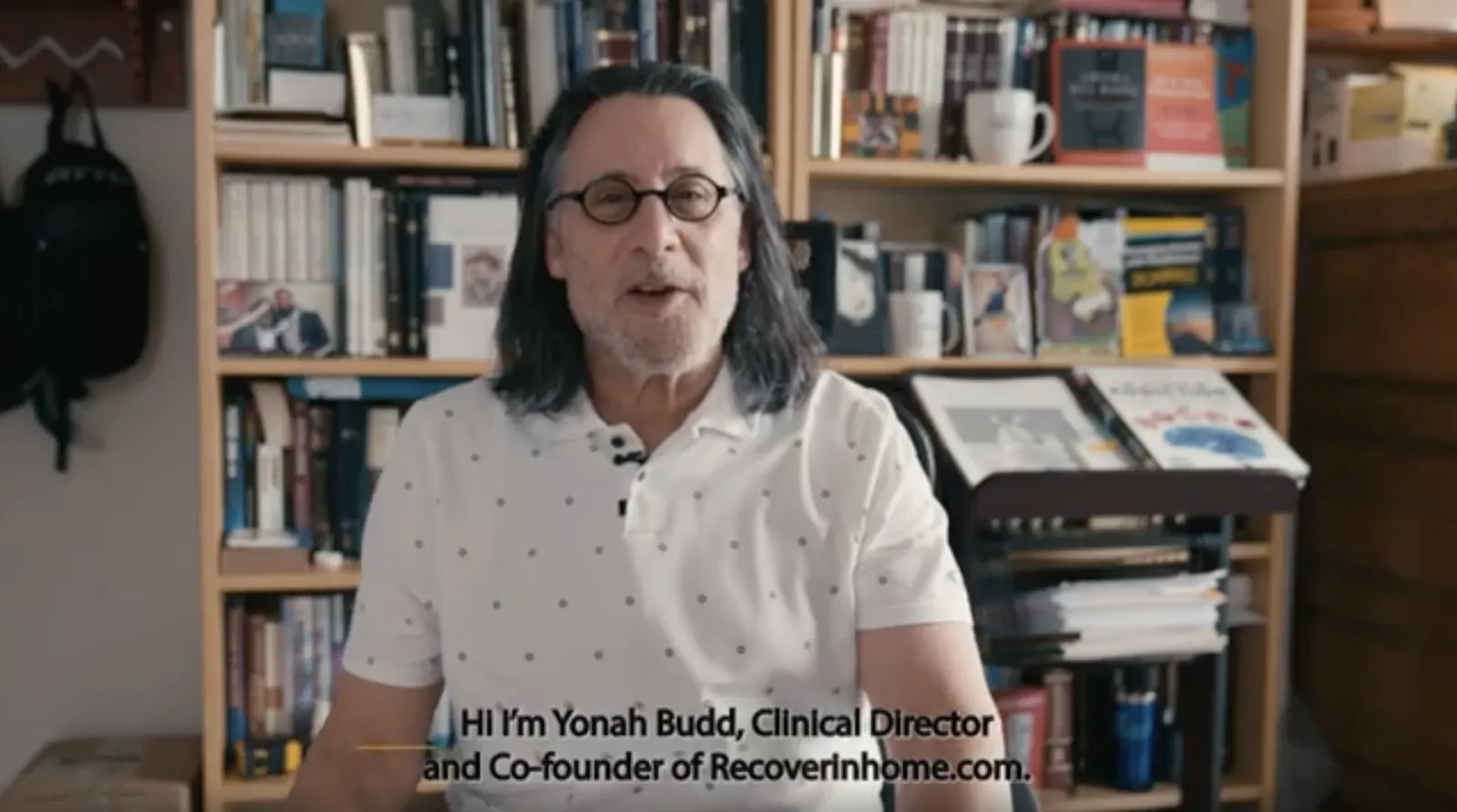 Yonah & team — first 30 days1:30
 YonahClinical lead & founder
What happens in the first 7 days
Hour 0 — Call intake
Reach the line 24/7. You can start the process without your loved one on the phone.
Hour 24 — Confidential conversation, fit assessment
We ask what matters, what's been tried, and whether in‑home is clinically appropriate.
Hour 72 — Clinician at the door, full medical + psychosocial assessment
Same depth residential programs run on day one — in your home.
Day 5 — Written plan delivered, reviewed with you
Goals, frequency, team, family involvement — aligned before treatment begins.
Day 7 — First treatment session in the home
Care is underway where life actually happens — not on a facility's schedule.
What you're actually buying.
- 01
A first conversation with intake
You — not your loved one — make this call. We listen, we ask the questions that matter, and we tell you honestly whether in‑home care is the right fit. ~30 minutes, no pressure to move forward.
- 02
A clinical assessment in their home
A licensed clinician runs a full assessment — substance use, medical history, mental health, family system, risk factors. This is the same depth of work a residential admissions team does on day one.
- 03
A written, individual plan
Goals, frequency, the team, the role you and other family members can play. You and your loved one approve it before any treatment begins.
- 04
Treatment in the home
Sessions at home on a schedule that fits your life. Frequency tapers as recovery stabilizes. Crisis support 24/7 throughout.
- 05
Care that survives the first year
Most relapse happens after the program ends. We don't have a discharge date — we walk with patients through the 12–18 month window that predicts long‑term sobriety.
What this is really for.
It's a Tuesday in eight months. Dinner is on the table at 6:30 because someone showed up at 6:30. The bag at the door doesn't get searched on the way out. The phone ringing late at night isn't a stomach‑drop anymore. You sleep through the night. Your kids stop watching you watch them.
That is the job. Recovery is the mechanism — but the job is getting the family back.
Three things most families don't know yet.
-
“Either residential or nothing” is a false choice.
For most patients with a stable home, in‑home clinical care matches residential outcomes — and beats them on long‑term retention, because the recovery is built where the life actually is, not in a controlled environment they have to leave.
-
“In‑home” is not “less clinical.”
Same licensed clinicians. Same protocols. Same medical oversight. The only thing that changes is the room. Accreditation Canada Certified care, NAADAC‑aligned professional standards, and review by Google's healthcare verification team — three independent lines of sight on clinical legitimacy.
-
Removing the friction of leaving home is why people accept help.
Many of the patients we treat have already refused residential — sometimes more than once. Bringing care to them isn't a softer option; it's the option that actually gets used. A treatment plan that gets executed beats a better one that doesn't.
What's actually stopping you from making the call.
“What if they refuse the moment I bring it up?”
The intake call is a conversation with you, not with them. We've helped thousands of families navigate that conversation — when to bring it up, what to say, what not to say. By the time we approach your loved one, you have a script and a clinician on standby.
“What if it's not 'real' treatment?”
Accreditation Canada (Primer Award), NAADAC‑aligned practice standards, provincial and national professional frameworks, and Google's healthcare advertising verification — multiple independent checks on whether you're working with licensed, accountable clinicians.
“What if a neighbour sees a clinician at the door?”
Visits are unmarked — no logos, no signage, no uniforms. We don't post case studies, we don't share faces, and we never confirm to anyone, ever, that someone is a client.
“What if they relapse?”
Eighty percent of our patients are still doing well at 18+ months — because we don't have a discharge date. We walk through the highest‑risk window with them. Relapse, when it happens, is clinical information, not failure.
“What if I'm enabling by making it easier?”
Friction doesn't drive recovery. Engagement does. The hardest path is the one where they refuse to start at all. Removing barriers to accepting care is what makes care happen.
“What does it actually cost?”
Cost depends on the plan — frequency, team, length. Some elements may be eligible under private insurance or extended health benefits. You receive a written estimate before anything begins. The first call is free.
What our families say afterwards.

I got my life and family back. RecoverInHome helped me learn to manage my depression and anxiety while recovering from alcohol addiction. Yonah connected directly with my root issues to help me resolve them and move forward with my life.

I wouldn't be here without their support. They helped me when no one else could. They understood me and my challenges, and helped empower me to make changes so recovery felt natural. They were with me every step of the way.
Independently certified and nationally affiliated — standards you can verify.
 Ontario — community safety & correctional standards
Provincial programs and pathways where mental health, addiction care, and justice systems intersect.
 National Center for Crisis Management
Crisis intervention and risk‑management frameworks for acute situations.
 Association for Addiction Professionals
Credentials, ethics, and continuing education standards for accountable practice.
 Canadian Mental Health Association
Recovery‑oriented care, inclusion, and reducing stigma.
 Accreditation Canada
Primer Award for healthcare quality standards.
Next step
The first call is yours, not theirs.
You don't need to have the conversation with your loved one before you talk to us. You don't need a plan, a strategy, or the right words. You need 30 minutes on the phone with someone who has walked thousands of families through this same week.
1 (866) 602‑9068
Open 24/7 · confidential · free
Nothing on this page commits you to anything. The first call is a conversation, not a sales call. If in‑home isn't the right fit, we'll tell you that and point you somewhere it is.